Industry
AI in Manufacturing: How Industry 4.0 and Smart Factories Are Being Rebuilt with AI
An industry analysis of how artificial intelligence is reshaping manufacturing — from predictive maintenance and computer vision quality control to digital twins, autonomous scheduling, and the next generation of smart factories.
By Axonix Labs · · 16 min read
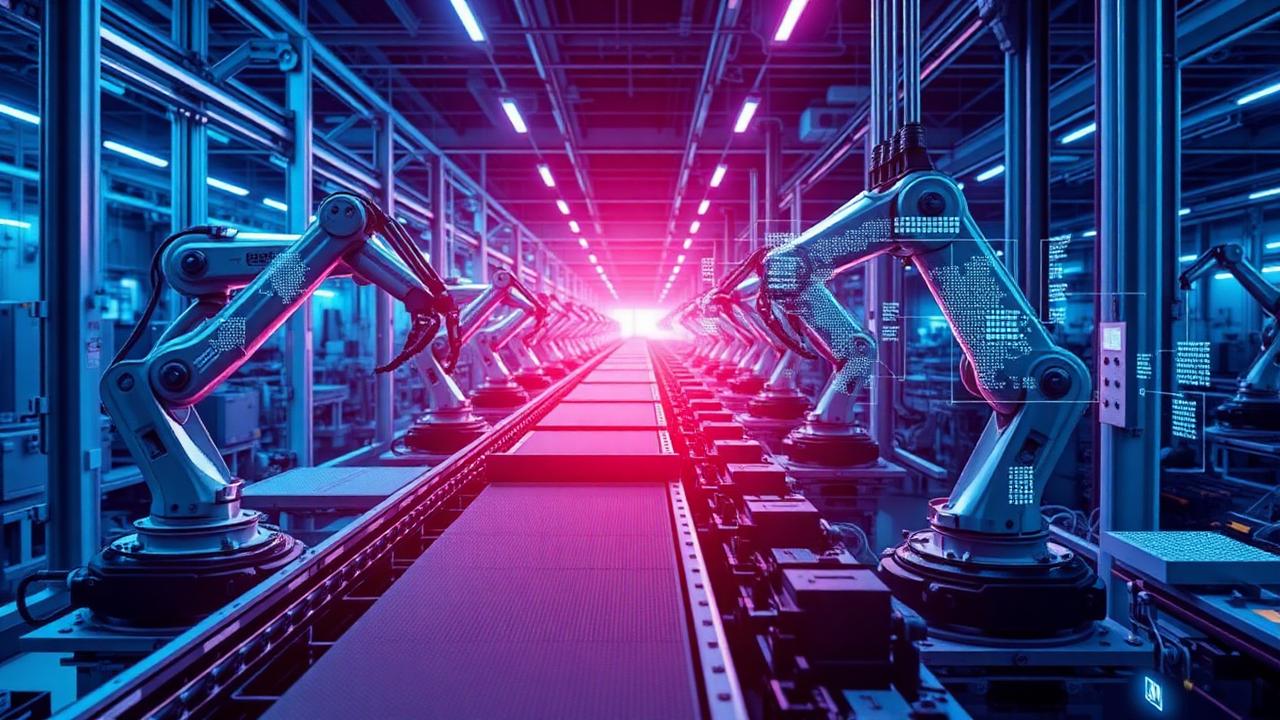
Manufacturing is, in many ways, the original AI industry. Long before generative AI captured public attention, factories were already using machine learning for predictive maintenance, vision systems for quality inspection, and optimisation algorithms for scheduling. What is changing in 2026 is not whether manufacturers use AI — it is the scale, the integration, and the ambition of what AI is now expected to do on the factory floor.
This article is an industry analysis of how AI is reshaping manufacturing, drawing lessons that apply to any organisation managing complex physical operations, distributed assets, or high-throughput production. Axonix Labs builds AI systems for industrial and operational environments, and the patterns described here are based on what consistently works — and what consistently fails — when AI meets the physical world.
Why Manufacturing Is the Hardest Test for Enterprise AI
Software AI is forgiving. A wrong recommendation in a marketing tool wastes a click. A wrong AI decision in a factory can damage equipment, injure workers, halt production, ship defective product, or breach regulatory tolerance. Manufacturing AI must therefore meet a higher bar than almost any other domain:
- **Real-time constraints** — decisions often have to happen in milliseconds, on the line, with no second chance
- **Heterogeneous data** — vibration sensors, temperature, pressure, camera feeds, PLC logs, ERP records, MES events, and operator notes all in one workflow
- **Edge deployment** — connectivity to the cloud is often limited, intermittent, or prohibited by security policy
- **Brownfield integration** — modern AI must coexist with equipment that is twenty years old and protocols that predate the internet
- **Workforce integration** — the system must work with operators, technicians, and engineers who already have established workflows
These constraints are exactly why manufacturing offers some of the most rigorous lessons in enterprise AI. What survives the factory floor tends to survive anywhere.
The Five AI Patterns That Are Reshaping Manufacturing
After observing AI deployments across discrete and process manufacturing, five patterns consistently deliver the highest impact:
1. Predictive and Prescriptive Maintenance
The first wave of industrial AI focused on predicting equipment failures before they happen. The second wave is now prescriptive — telling maintenance teams not just that a failure is coming, but what to do about it, when, and with what parts. Done well, this can reduce unplanned downtime by thirty to sixty percent and extend asset life significantly. Done poorly, it generates false alarms that erode trust until the system is ignored.
2. Computer Vision Quality Control
Vision systems have moved well beyond simple defect detection. Modern systems combine high-resolution imaging, deep learning models trained on plant-specific defect libraries, and continuous learning loops that improve with every shift. Vision AI now routinely catches defects human inspectors miss, classifies them by root cause, and feeds that information back into upstream process control. Our computer vision applications guide covers the broader pattern.
3. Process Optimisation and Autonomous Control
Reinforcement learning and advanced control models are increasingly used to tune process parameters in real time — optimising for yield, energy use, throughput, or quality simultaneously. The most mature deployments operate as a closed loop: the AI proposes a setpoint, the control system applies it within safety limits, the outcome is measured, and the model learns. Industries with continuous processes — chemicals, steel, pulp and paper, semiconductors — see particularly strong results.
4. Digital Twins and Simulation-Driven Decisions
A digital twin is a live, data-driven model of a physical asset, line, or plant. Combined with AI, digital twins allow manufacturers to simulate the impact of decisions — a new product mix, a maintenance schedule, a process change — before applying them to the real system. This is particularly valuable for capacity planning, energy optimisation, and changeover scheduling. The cost of bad decisions falls dramatically when they can be tested in a simulation first.
5. Intelligent Scheduling and Supply Synchronisation
AI-driven scheduling considers far more variables than any human planner can hold in mind: machine availability, operator skill, material lead times, energy prices, customer priority, quality history, and changeover costs. Modern systems re-plan continuously as conditions change, and increasingly link directly into supply chain systems so that a disruption upstream is reflected in production decisions within minutes, not days. Our AI in supply chain management guide covers the connection between the factory and the broader logistics network.
The Edge-Cloud Architecture Behind Modern Smart Factories
Cloud AI alone cannot run a factory. Cloud-only architectures fail the moment connectivity drops or latency exceeds the control loop tolerance. Edge-only architectures cannot benefit from cross-site learning or large-scale analytics. Modern smart factory architectures are explicitly hybrid:
- **Edge tier** — small, fast models running on local gateways and devices for real-time inference, control, and safety
- **Plant tier** — site-level systems that aggregate data, train and deploy models, and coordinate across lines
- **Enterprise tier** — cloud systems that learn across multiple plants, benchmark performance, and feed insights back down to each site
Our edge AI guide covers this architecture in more depth.
The Failure Modes That Stall Manufacturing AI
The same failure patterns appear across manufacturers of every size and sector:
- **Pilot purgatory** — promising pilots that never scale because they were built without an enterprise architecture in mind
- **Data fragmentation** — sensor data, MES data, and ERP data that never meet, leaving every model working with a partial picture
- **Operator distrust** — AI systems imposed on the floor without involving the people who actually run the line
- **Over-reliance on vendor lock-in** — proprietary platforms that promise everything and deliver a closed ecosystem
- **Underinvestment in data infrastructure** — sophisticated models running on dirty, sparse, or unreliable data
- **No measurement** — AI initiatives that cannot prove their impact on OEE, yield, downtime, or cost
Our why AI projects fail analysis covers these patterns in detail.
The Workforce Reality
Manufacturing AI does not replace operators, technicians, or engineers. It changes what they do. Predictive maintenance shifts technicians from reactive repair to planned intervention. Vision QC shifts inspectors to root-cause analysis. Optimisation systems give process engineers a much larger design space to explore. The plants that win with AI are the ones that treat the workforce as a partner in the system, not an obstacle to it. This is as much an organisational design challenge as a technical one.
How Axonix Labs Approaches Manufacturing AI
We build manufacturing AI systems with the assumption that they will run for years, on imperfect data, in environments where downtime is not an option. Our approach combines:
- Pragmatic edge-cloud architecture matched to each plant's connectivity and security profile
- Computer vision, predictive analytics, and optimisation patterns proven in industrial settings
- Strong integration with MES, SCADA, ERP, and historian systems
- Continuous evaluation against the metrics that operations actually cares about — OEE, yield, downtime, energy, scrap
- Workforce enablement so operators and engineers become more effective, not displaced
Our AI solution development guide describes the broader engineering discipline behind these systems.
Getting Started
If you lead operations, plant engineering, or digital transformation in a manufacturing business, the strongest starting point is rarely a moonshot. It is a focused use case with clear data, clear measurement, and clear operational ownership — predictive maintenance on a critical asset, vision QC on a known defect class, scheduling for a single bottleneck line. Prove the pattern, prove the value, and build the architecture that lets the next ten use cases come faster.
Contact Axonix Labs to discuss AI for your manufacturing operations. Explore our AI solutions, read about predictive analytics for business decisions, or learn about AI for operations efficiency.