Enterprise AI
Optimizing Modern MLOps: Engineering High-Performance Lifecycles for Mission-Critical Model Reliability
Master the transition from pilot to production with enterprise-grade MLOps frameworks and automated model lifecycle management.
By Axonix Labs · · 12 min read
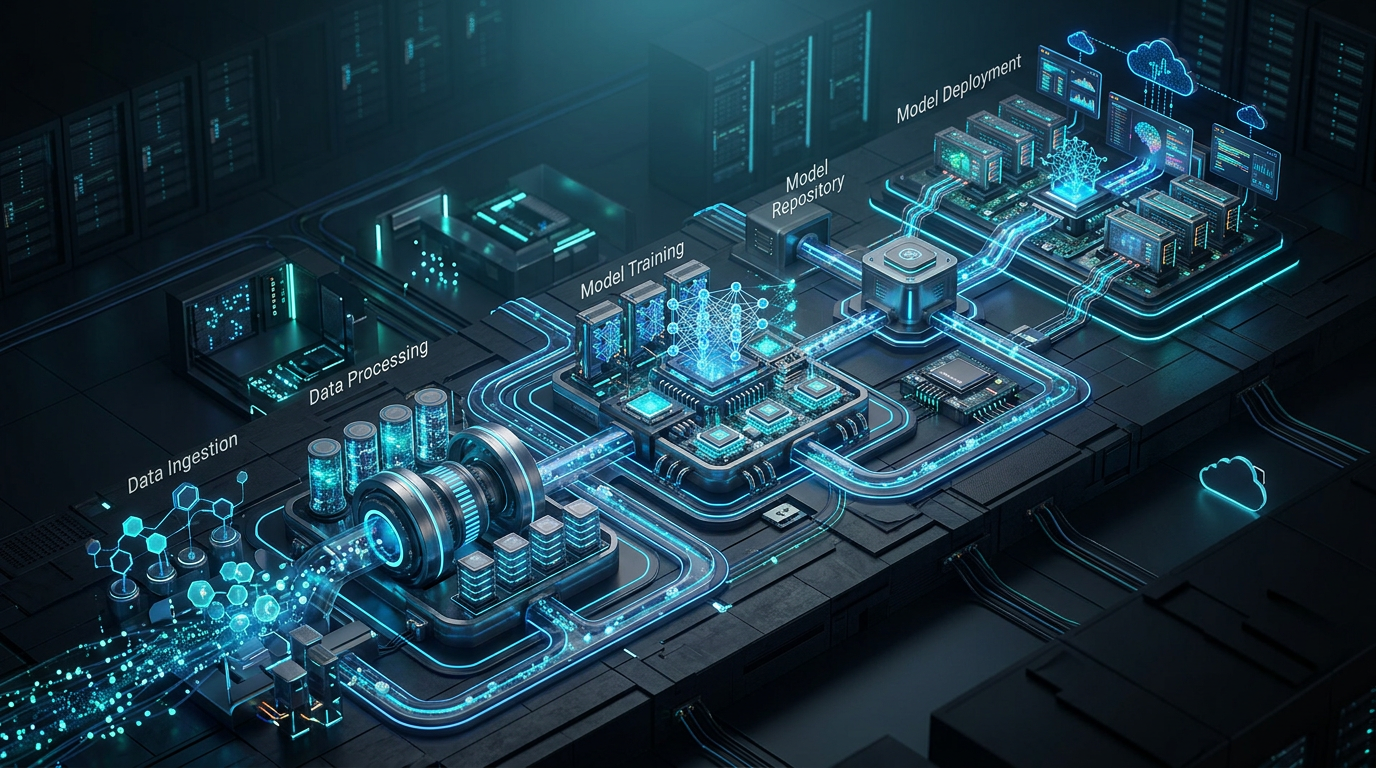
The Production Gap: Why Enterprise AI Requires Custom Lifecycle Engineering
For many global organizations, the initial excitement of discovering a high-accuracy AI model quickly fades once the realities of production set in. Statistical drift, silent failures, and manual retraining loops often turn a high-potential asset into a high-maintenance liability. At Axonix Labs, we define the MLOps layer not just as a set of tools, but as a discipline of engineering for longevity that ensures intelligence remains accurate over time.
The Five Pillars of the Axonix MLOps Framework
To move beyond the 'black box' mentality, enterprise leaders must evaluate their AI maturity across five distinct dimensions:
- Data Versioning and Lineage: Knowing exactly which data snapshot trained which model.
- Automated Experiment Tracking: Institutionalizing the 'why' behind model performance changes.
- CI/CD for ML: Continuous integration and deployment pipelines specifically tuned for training weights and weights files.
- Monitoring and Observability: Detecting concept drift before it impacts the bottom line.
- Human-in-the-loop Governance: Ensuring manual review is triggered when models operate outside confidence intervals.
Overcoming Model Decay and Statistical Drift
Even a perfect model begins to decay the moment it hits production because the real world is dynamic. A demand forecasting model trained on 2024 data likely cannot predict the market shifts of 2026 without active intervention. This is why predictive analytics transformation requires more than just a one-time setup. Our approach involves setting up automated triggers—when the statistical distribution of input data shifts by more than a pre-defined threshold (e.g., using Kolmogorov-Smirnov tests), the system automatically initiates a shadow training run to compare the current model against a newly retrained challenger.
Infrastructure Agnostic versus Cloud Native Architectures
One of the most frequent questions we receive at Axonix Labs is whether to stick to native tools like AWS SageMaker or build an agnostic stack using Kubeflow or MLflow. The answer depends on your scale. For global enterprises with multi-cloud footprints, we advocate for integrated enterprise AI best practices that prevent vendor lock-in, allowing models to move from cloud to on-premise as compliance or cost requirements dictate.
The Role of Automated Retraining in Business Intelligence
When AI is used for autonomous decision-making, the cost of error is exponential. We build retraining loops that aren't just scheduled, but behavioral. If an AI agent fails to resolve a customer query and requires a human hand-off, that interaction is automatically labeled and fed back into the fine-tuning queue. This creates a flywheel of intelligence where the system grows smarter through its own friction points.
Implementing the Axonix MLOps Pipeline
Tactical Tip: Start by automating your 'Model Registry.' Before you automate training, ensure you have a single source of truth for versioned, validated, and signed models that can be rolled back in seconds if production anomalies occur.
1. Pipeline Orchestration: Mapping the flow from raw data ingestion to served prediction. 2. Validation Gates: Implementing unit tests for data (ensuring no null values or outlier spikes) and unit tests for models (protecting against bias or catastrophic forgetting). 3. Deployment Strategies: Utilizing Canary deployments to test new models on 1% of traffic before a full-scale roll-out.
Financial Impact: Reducing the Total Cost of Ownership (TCO)
Senior leadership often views MLOps as an additional expense. In reality, it is a cost-containment strategy. By automating the monitoring and retraining of models, Axonix Labs has seen clients reduce their technical debt by up to 60%. Instead of a team of data scientists spending 80% of their time on manual maintenance, they can focus on building new, revenue-generating applications.
Strategic Partnership with Axonix Labs
Building an MLOps capability in-house is a multi-year journey fraught with hiring challenges and architectural missteps. As a global partner, Axonix Labs provides the framework, the engineering talent, and the production-tested logic to get your models into the wild and keep them performing at peak efficiency. We don't just build the model; we build the machine that sustains the model.